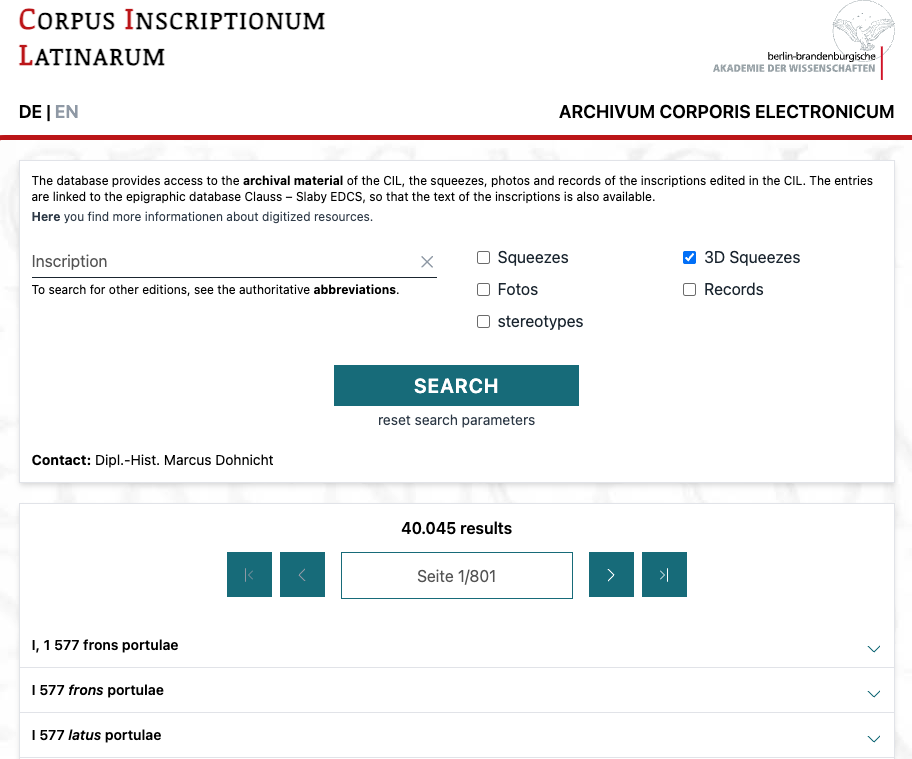
The Archivum Corporis Elecronicum project
October 15, 2014.
A collaborative team from the Corpus Inscriptionum Latinarum (CIL) at the Berlin-Brandenburg Academy of Sciences and Humanities, and the Digital Epigraphy and Archaeology group at the University of Florida have received a grant award from the Einstein Foundation. This collaborative project titled “3D Digitization of Squeezes for the Archivum Corporis Elecronicum” is lead by Dipl.-Hist. Marcus Dohnicht and is aiming to digitize in 3D and disseminate electronically squeezes from the Corpus Inscriptionum Latinarum (CIL).
Description
GAINESVILLE, Fla.
September 12, 2016.
A collaborative team from the Corpus Inscriptionum Latinarum (CIL) at the Berlin-Brandenburg Academy of Sciences and Humanities, and the Digital Epigraphy and Archaeology group at the University of Florida have received a grant award from the Einstein Foundation 1.This collaborative project titled “3D Digitization of Squeezes for the Archivum Corporis Elecronicum” is lead by Dipl.-Hist. Marcus Dohnicht and is aiming to digitize in 3D and disseminate electronically squeezes from the Corpus Inscriptionum Latinarum (CIL)2.
The proposed project is expected to be completed by the middle of 2017. The database that will be created will contain 2D and 3D digitized records of the squeezes as well as metadata entries regarding the original inscriptions.
During the summer of this year, the team performed a series of pilot 3D digitization experiments at the Berlin-Brandenburg Academy of Sciences and Humanities in order to establish an efficient process that can be followed in this project. In this pilot study selected paper casts of inscriptions were digitized using the shape-from-shading framework3 of the Digital Epigraphy Toolbox.
Below you can interact with one of the preliminary 3D digitized models. Use touch gestures or mouse movements to interact with the digital squeeze. You can rotate, zoom, relight and view in full screen information about this inscription.
A sample 3D digitized inscription from the Corpus Inscriptionum Latinarum (CIL). Touch your screen to interact with the 3D model using the Digital Epigraphy Toolbox.This important historical evidence can now be easily accessed and studied by scholars using this on-line viewer. One of the advantages of the Digital Epigraphy Toolbox viewer is that it can be easily embedded into websites or other databases by using the following HTML tag:
The above HTML tag corresponds to the sample inscription from the squeeze collection at the Archivum Corporis Elecronicum. You can find the corresponding embed-tag of other exhibits within the information provided in their records in the Digital Epigraphy Toolbox4.
The DEA editorial team
References:
1. Einstein Foundation https://www.einsteinfoundation.de/
2. The Archivum Corporis Elecronicum project https://cil.bbaw.de/ace/
3. A. Barmpoutis, E. Bozia, R. S. Wagman, “A novel framework for 3D reconstruction and analysis of ancient inscriptions”, Journal of Machine Vision and Applications
2010, Vol. 21(6), pp. 989-998. PDF
4. Digital Epigraphy Toolbox, www.digitalepigraphy.org/legacy/toolbox.
The Digital Epigraphy Toolbox was funded in part by the NEH grant HD-51214-11.
Additional information
| URL |
|---|


